
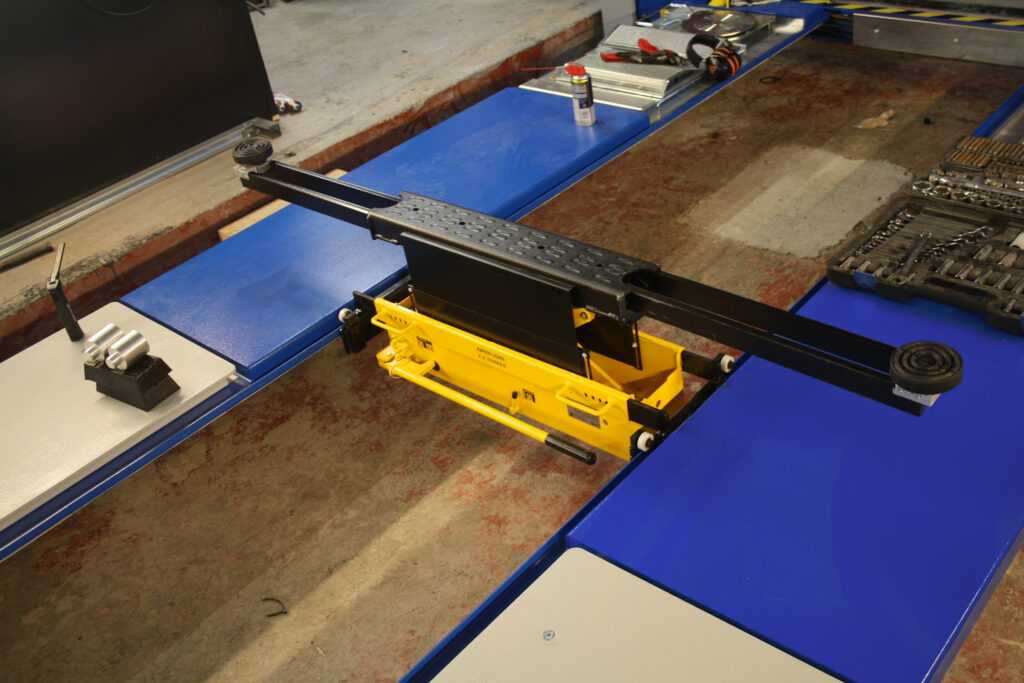
Is Your MOT Bay Future-Proof? The 2026 Jacking Beam Rules You Need to Know
If you’ve been keeping an eye on the latest DVSA updates, you’ll know that the field of MOT testing is shifting dramatically. With the motor industry moving at breakneck speed towards heavier, wider electric vehicles (EVs), the workshop equipment we’ve relied on for years is having to level up.
The DVSA recently released Special Notice 04/25, which is important for anyone running a Class 4 bay or a dual Class 4 & 7 bay. Starting 1st April 2026, the standards for jacking equipment will change.
There’s no need to worry or replace your current equipment right away. Here’s what’s changing, why it matters, and what your business may need to do.
Why the Change?
It’s no secret that cars are getting bigger and heavier. Between the massive battery packs in EVs and the general trend toward chunky SUVs, the old “standard” jacking points are becoming a thing of the past.
Modern EVs often have lifting points set farther apart to protect sensitive battery compartments. To keep MOT testers safe and prevent vehicle damage, the DVSA now requires new jacking beams to handle the weight and reach these wider points.
The New Specs: The “Big Two”
Starting in April 2026, any new or replacement jacking equipment used for Class 4 MOT testing must meet two key requirements:
- Increased Capacity: Jacking equipment must have a minimum Safe Working Load (SWL) of 2 tonnes (2,000kg).
- Extended Reach: This is the crucial one. The distance between the centre of the lifting pads must now be at least 1,700mm.
Many older beams only reach 1,500mm or 1,600mm. They may be strong enough to lift the weight, but they don’t have the reach needed for today’s wider vehicles. If you run a dual Class 4 & 7 MOT bay, you must meet both standards: a minimum SWL of 2.6 tonnes and a pad distance of at least 1,700mm.
Does This Apply to Me?
If your current jacking beam works well, you don’t need to change anything for now. You can keep using your existing equipment. However, after 1st April 2026, you’ll need to meet the latest regulations in these situations:
- You’re opening a new test centre and haven’t carried out any MOT tests yet.
- You’re restarting MOT tests after a period of no testing.
- You’re adding an extra test lane to your existing site.
- You’re replacing an old, broken jacking beam.
- You’re going through a Change of Entity (for example, if you’re taking over an existing garage or changing your business structure).
Remember, after 1st April 2026, if your situation matches any of those listed above, your jacking equipment must meet the new standards.
Training for the Future
Updating your jacking beam is mainly about keeping your workplace safe. As an MOT tester, you know that not being able to lift a heavy EV properly is more than a minor inconvenience; it’s a real safety risk.
That’s why we do more than supply equipment. We also make sure your team is fully trained. Our training programs are being updated to match the new standards, so your technicians know how to handle the heavier, wider vehicles now common in workshops.
Don’t Wait for the Deadline
April 2026 may seem far away, but if you’re planning an upgrade or starting something new, it’s smart to future-proof your investment now.
We already offer a full range of jacking beams that meet or exceed the 2.0t SWL and 1,700mm reach requirements. Buying compliant MOT equipment now means you won’t be surprised by a change in ownership or an unexpected equipment failure later.
Want to see if your current bay meets the new standards? Or do you want to book your team for the latest MOT refresher training? Get in touch by calling our team on 0208 498 1288. We’re here to help keep your business compliant and your MOT testers safe.