
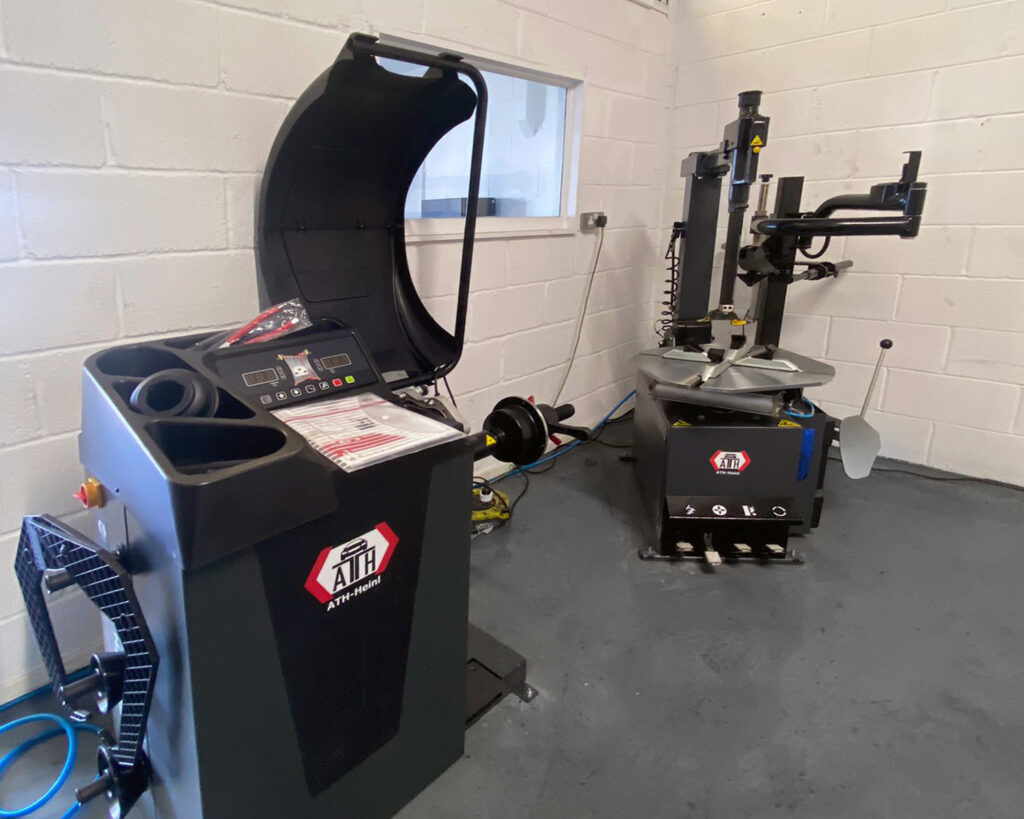
A good wheel balancer is one of those pieces of garage equipment that quietly earns its keep every day. Customers may not always ask what machine you use, or whether your balancer has laser weight positioning, automatic data input or a diagnostic load force function. They simply expect their car to leave the workshop without steering-wheel vibration, wobbles that cause uneven tyre wear, or a return visit because “something still feels wrong”.
That is why choosing the right wheel balancer matters. For an independent garage, tyre bay, mobile tyre-fitting business, fast-fit centre, or MOT workshop, the right wheel-balancing machine can improve accuracy, speed up tyre work, reduce customer comebacks, and create another reliable revenue stream. The wrong machine can do the opposite. It can slow technicians down, lead to avoidable errors, cause issues with modern alloy wheels or vans, and leave your workshop limited just when your tyre service starts to grow.
At V-Tech Garage Equipment, we have positioned ourselves as a one-stop shop for premium quality garage equipment, including tyre changers and wheel balancers, with nationwide supply and installation support through V-Tech Group. That makes the buying decision more than a simple price comparison. You are not just buying a machine. You are choosing a long-term workshop tool that needs to match your workload, available space, technicians, the wheels you service, and the level of accuracy your customers expect.
What Does a Wheel Balancer Actually Do?
A wheel balancer measures the imbalance in a wheel and tyre assembly and tells the operator where to apply balancing weights so the assembly rotates smoothly. In simple terms, it helps even out the weight distribution around the wheel. Wheel balancing is best described as equalising the combined tyre and wheel’s weight distribution by adding small weights until it rotates evenly.
This is not a “nice to have” after a tyre change. It is part of professional tyre fitting. When a tyre is removed, replaced, repaired or rotated, the balance of the wheel and tyre assembly can change. Even small differences in weight can become noticeable once the wheel is spinning at road speed. The result is often vibration through the steering wheel, seat or floor, usually most obvious at higher speeds.
Modern wheel balancing machines offer much more than just spinning a wheel and displaying a number. Depending on the model, they can perform static and dynamic balancing, support alloy-wheel settings, facilitate adhesive weight placement, balance motorcycle wheels, and include features like optimisation, laser guidance, automatic measurement, and diagnostic checks. When comparing machines, it’s essential to consider the available balancing modes, data entry options, display type, measurement accuracy, cones, adaptors, clamping systems, space needs, and power supply.
Why Wheel Balancing Matters for a Garage Business
From the customer’s perspective, wheel balancing is about comfort and confidence. From the workshop’s point of view, it is about quality control, efficiency and reputation. A customer who pays for tyres and then feels vibration on the motorway is unlikely to blame the tyre manufacturer first. They are more likely to question the garage that fitted the tyres.
Unbalanced wheels can affect handling, create vibration, contribute to uneven tyre wear, increase stress on suspension components and reduce fuel efficiency. The RAC describes common symptoms, including vibration through the steering wheel, floor, or seats, which may lead to uneven tyre wear, poor handling, suspension stress, and reduced fuel efficiency.
For garages offering MOT work, it is worth being precise. Wheel balancing itself is not an MOT test item, but tyres, road wheels, wheel bearings, suspension and TPMS are all covered within the DVSA MOT inspection manual. The manual includes checks on wheel condition, tyre condition, tyre tread depth, tyre fitment, TPMS, and suspension. For most passenger vehicles and light goods vehicles up to 3,500kg, the primary tyre grooves must have at least 1.6mm tread depth across the central three-quarters and around the circumference.
That does not mean a balancer replaces good inspection, alignment checks or tyre pressure checks. It means balancing sits within a wider tyre and wheel service process. A workshop that fits tyres, checks valves, monitors TPMS, properly balances wheels, and advises customers on tyre condition offers a more complete service than one that treats balancing as an afterthought.
Start With Your Workshop Type and Workload
The best wheel balancer for one garage may be the wrong choice for another. A mobile tyre fitter working from a van has different needs to those of a high-volume tyre depot. A general repair garage that fits a few sets of tyres per week has different priorities from a fast-fit centre balancing dozens of wheels a day.
Before looking at brands or prices, start with these questions.
- How many wheels will you balance per day or per week?
- What percentage of your work is cars, vans, SUVs, motorcycles or performance vehicles?
- Do you regularly handle large alloy wheels?
- Do you fit tyres as a core service, or only occasionally?
- Are you planning to grow your tyre fitting revenue?
- How experienced are your technicians?
- How much workshop floor space do you have?
- Do you need a machine that works alongside a tyre changer in a compact bay?
It is important to consider workshop volume, vehicle and wheel types, budget, return on investment, space, technician skill level, power requirements and future growth as key decision factors when choosing a wheel balancer.
That future growth point is important. Many garages buy for today’s workload, then outgrow the machine within a year. If you currently fit tyres occasionally but want to build a tyre bay, a cheap manual or entry-level balancer may hold you back. If you already have a steady tyre service, a semi-automatic or fully automatic wheel balancer can save time on every job and reduce operator error.
Manual, Semi-Automatic, Fully Automatic or Diagnostic?
Most wheel balancers fall into four broad categories: manual or hand-spin balancers, semi-automatic balancers, fully automatic 3D balancers, and diagnostic machines such as road-force balancers.
A manual wheel balancer is the budget option. It suits very low-volume tyre work, occasional use or mobile setups where cost and footprint are the main concerns. The operator usually enters measurements manually and may need more skill to achieve consistent results. The benefit is affordability. The compromise is speed and repeatability.
A semi-automatic wheel balancer is a reliable middle ground for many independent garages. These machines automate certain measurements, minimise manual input, and provide a better balance between price, accuracy, and productivity. Some describe semi-automatic models as an optimal mix of speed and cost, while others see semi-automatic balancers as durable workhorse options for many independent garages.
A fully automatic 3D wheel balancer is designed for faster operation and fewer input errors. These machines can automatically measure wheel parameters, making them well-suited to busy garages, alloy wheel work and high-volume tyre bays. Remember that fully automatic 3D balancers measure parameters automatically and are particularly suitable for alloys and high-volume tyre bays.
A diagnostic wheel balancer, often associated with load-force measurement, is designed for specialist workshops that want to address more complex vibration issues. A standard balancer corrects imbalance. A diagnostic balancer can go further by identifying issues such as tyre uniformity, rim runout, bead seating problems, or other non-balance vibration causes. Some specialist machines use a diagnostic load roller to simulate road conditions and detect vibration issues that standard balancers may miss.
Motorised vs Non-Motorised Wheel Balancers
A non-motorised wheel balancer can make sense for occasional or mobile use, but most commercial garages will benefit from a motorised wheel-balancing machine. A motorised balancer spins the wheel at a consistent speed, helping improve repeatability and reducing technician effort. At V-Tech, we recommend using motorised balancers in nearly all garage settings due to their ability to spin under power, at a steady speed, and with shorter cycle times.
For a busy tyre bay, the difference is not just convenience. It is throughput. If a technician saves even a small amount of time on each wheel, that saving quickly multiplies over the course of a full day of tyre fitting. Faster cycle times also help when several vehicles are waiting, or when tyre changing, balancing and wheel refitting all need to happen efficiently in one bay.
For a mobile tyre service, the choice is more nuanced. A compact non-motorised balancer may be suitable where space, weight and power supply are limited. However, if the mobile business handles steady daily tyre fitting, a compact motorised option may still be worth considering, provided it fits the van layout and power setup.
Data Input: Manual, Semi-Automatic and 3D
Data input is one of the biggest differences between cheap wheel balancers and professional workshop machines. The machine needs accurate wheel measurements to calculate where weights should be fitted. If those measurements are entered incorrectly, the balance result can be wrong before the spin even begins.
Manual input machines rely heavily on the operator. The technician measures and enters values such as wheel diameter, width and distance. This can work, but it takes time and leaves more room for mistakes, especially if multiple staff members use the machine.
Semi-automatic machines reduce the input burden. They may automatically measure some dimensions while the operator enters others. For a small or medium workshop, this can offer a sensible upgrade without moving straight to the highest price bracket.
Fully automatic or 3D automatic wheel balancers measure all essential parameters autonomously, saving time and minimising operator errors. Some high-end diagnostic balancer models employ advanced technology to determine wheel dimensions, choose weight modes, and assess rim runout.
For garages with less experienced technicians, automatic data entry can be especially valuable. Training still matters, but the machine helps enforce consistency. For high-volume tyre bays, it removes small, repetitive tasks that slow the process.
Laser Weight Positioning and Alloy Wheel Modes
Modern vehicles often have larger alloy wheels, more visible rims and customers who care about appearance. That makes weight placement more important. Clip-on weights are not always suitable, and adhesive weights are often used to keep the finish clean.
Laser positioning systems guide the operator to the correct point for adhesive weights. It should be noted that laser systems show where to place adhesive weights, reduce balancing errors and are useful for hidden weights on alloy wheels.
For garages that regularly service alloy wheels, performance cars, SUVs, and newer vehicles, laser weight positioning is a serious feature rather than a luxury. It improves accuracy, helps keep wheel weights hidden and gives the technician a clearer process. It can also reduce the likelihood of repeat spins due to poor placement.
Look for alloy-wheel modes, split-weight programmes and hidden-weight functions. These features allow the machine to calculate adhesive weight positions behind spokes or in less visible areas of the rim. The result is a cleaner finish and a more professional service.
Cones, Adaptors and Clamping Systems
A wheel balancing machine is only as accurate as the way the wheel is mounted. Poor centring can create a false imbalance reading, leading the technician to chase a problem that was caused by the balancer rather than the vehicle.
Standard cones will suit many passenger car wheels, but they will not cover every job. If your garage services vans, larger SUVs, light commercial vehicles or motorcycles, you may need additional adaptors. While it is true that standard cones fit most passenger car wheels, van and LCV adaptors are required for vehicles such as Transits and Transporters, and motorcycle adaptors are needed if you service bikes.
A quick-release nut is also worth considering. It does not make the machine more glamorous, but it saves time every time a wheel is mounted or removed. In a busy workshop, that matters.
Advanced centring systems can improve accuracy on high-end alloys and more sensitive wheel assemblies. If your workshop handles prestige vehicles, modified cars or customers who are highly sensitive to vibration, better clamping and centring equipment may be more important than the base machine price suggests.
Space, Power and Workshop Layout
A wheel balancer is not huge compared with a lift or MOT bay, but it still needs enough space to be safe and practical. You need room for the machine, room for the operator, room to load and unload wheels, room for wheel weights and tools, and a sensible position close to the tyre changer.
It is suggested you have an approximate footprint of 1m by 1.2m, with side clearance for loading and unloading, typical 230V single-phase power and machine weights commonly between 80kg and 140kg, depending on the model. Always check the exact specification before buying, especially if the machine is going into a tight workshop or mobile tyre van.
The ideal position is close enough to the tyre changer to create a smooth workflow, but not so close that technicians are forced to work awkwardly. Wheels are heavy, repetitive handling is tiring, and clutter around tyre equipment increases the chance of mistakes or damage.
If you are planning a new tyre bay or workshop refit, map the tyre process from start to finish. Vehicle comes in. The wheel comes off. The tyre is demounted. The new tyre is mounted. Assembly is inflated. The wheel is balanced. Wheel goes back on the vehicle. Torque is checked. TPMS or pressure checks are completed. The wheel balancer should sit naturally in that flow.
Accuracy, Repeatability and Cycle Time
Accuracy is not just about the number displayed on the screen. It is about repeatability. A good wheel balancer should give consistent results when the same wheel is removed and remounted correctly. If results vary too much, technicians lose confidence, and jobs take longer.
Remember that higher-quality balancers provide finer gram resolution, better repeatability, and quicker balancing cycles. Additionally, most motorised balancers typically take about 6 to 10 seconds per spin cycle.
Cycle time becomes more important as volume increases. A small garage balancing a few wheels a week may not notice the difference between an entry-level cycle and a faster professional machine. A tyre depot balancing full sets all day absolutely will.
However, do not buy on spin speed alone. A machine that spins quickly but requires slow data entry, awkward clamping or repeated corrective spins may not be faster in real workshop use. Look at the complete process: mount, measure, spin, fit weights, check and remove.
Load Force and Diagnostic Balancing: When Is It Worth It?
Most garages do not need a diagnostic load force balancer for every customer. A good semi-automatic or fully automatic wheel balancer will be sufficient for many tyre-fitting and repair businesses. However, diagnostic balancing becomes valuable when a workshop regularly deals with vibration complaints, high-performance vehicles, premium wheels or customers who have already been elsewhere without the problem being solved.
Load force balancing goes beyond basic weight imbalance correction. These systems employ a load roller to mimic road conditions, allowing for the detection of problems like tyre uniformity issues, rim runout, improper bead seating, and tyre pull.
This matters because not every vibration is caused by imbalance. A tyre can be balanced in the traditional sense but still cause vibration due to stiffness variations, a bent rim, or poor bead seating. A diagnostic balancer helps the technician identify whether the issue is weight-, tyre-, rim-, or mounting-related.
For a specialist motorsport tyre centre, a prestige workshop, or a very high-end dealership environment, diagnostic balancing can become a strong selling point. For most workshops, there isn’t a strong business case for these machines.
Matching the Machine to Your Customer Base
For a small independent garage, a semi-automatic wheel balancer is often the sensible starting point. It offers higher productivity than a manual model, without the higher cost of a fully automatic 3D machine. Look for a motorised balancer, clear display, reliable cones, alloy modes and good support.
For a busy general repair workshop, a fully automatic or 3D automatic wheel balancer is more attractive. It reduces operator error, speeds up data input and suits a wider range of wheels. Add laser weight positioning and a quick-release nut if tyre fitting is a regular service.
For a dedicated tyre bay or fast-fit centre, the wheel balancer should be chosen for throughput and accuracy. A fully automatic machine with laser positioning, optimisation mode, van adaptors and strong clamping equipment is usually a better investment than a cheaper machine that slows the whole bay down.
For a mobile tyre-fitting business, compact size, low weight, low power requirements, and durability are key. Non-motorised options can work for occasional use, but a compact motorised balancer may be better if the business is serious about daily tyre fitting.
For motorcycle workshops, do not assume a standard car wheel balancer will do the job. You need the correct motorcycle adaptors and modes.
For van and light commercial work, check shaft capacity, wheel diameter, weight limits and LCV adaptors. We specifically recommend motorised machines with LCV or van adaptors and at least semi-automatic sensing for larger vans.
Budget and Return on Investment
Price matters, but it should not be the only buying criterion. A cheaper wheel balancer can become expensive if it causes delays, limits the work you can accept or leads to customer comebacks.
A quick internet search gives you indicative price bands:
- under £1,000 for manual or hand-spin equipment
- £1,000 to £2,000+ for semi-automatic machines
- £2,000 to £4,000+ for fully automatic machines
- £5,000 to £10,000+ for diagnostic load-force-style equipment
These are guide ranges only, and the actual cost will depend on the brand, specifications, supplier offers, and included accessories.
To judge return on investment, consider more than just the machine cost. Consider the number of tyres fitted per week, balancing charges, time saved per wheel, the reduction in repeat work, the ability to handle larger wheels, and whether the machine helps you sell more complete tyre services.
Bear in mind that wheel balancing should be a chargeable service, with typical UK prices of £5 to £10 per wheel. Having it as a separate line item on an invoice, alongside tyre disposal, shows the real value of the service you offer. Local pricing varies, but the point is straightforward: wheel-balancing equipment can generate direct revenue while also supporting tyre fitting, repair, and customer retention.
If you are already fitting tyres, a better balancer may not need to bring in many extra jobs to make sense. It may pay back through time saved, fewer mistakes, and more confidence when taking on alloy wheels, vans, or higher-value work.
Maintenance, Calibration and Safe Use
A wheel balancer is precision workshop equipment. It needs to be installed correctly, kept clean, used properly and maintained. If the shaft, cones, clamping system or measurement arm are damaged, accuracy can suffer.
HSE guidance on work equipment maintenance states that maintenance should be carried out by competent people with suitable information, instruction, and training. It also recommends planned maintenance, reporting procedures for damaged or faulty equipment and using the manufacturer’s instructions as a guide.
For a garage, this means choosing a supplier that can support the machine after delivery. Ask about installation, calibration, warranty, spare parts, technician training and service response. Key areas of supplier support include professional installation, maintenance, calibration, spare parts, warranty, and technical assistance.
Do not overlook training. Even the best fully automatic wheel balancer can be misused. Technicians need to know how to clean mounting faces, choose the right cone or adaptor, enter or verify data, select the correct programme, place weights accurately and recognise when a vibration issue may be caused by something other than imbalance.
Should You Buy a Tyre Changer and Balancer Package?
If you are setting up a new tyre bay, expanding a general workshop, or launching a mobile tyre-fitting service, a tyre changer and wheel balancer package can be a smart choice. The equipment is designed to work together in a single tyre service process, and packages can simplify specification, installation, and budgeting.
You can find tyre changers and wheel balancers within V-Tech’s wider garage equipment range, and remember that our tyre-changing equipment packages with compatible wheel balancers can offer value and convenience for workshops getting started with tyre changing.
The key is to avoid an unbalanced package. There is little point in buying a highly capable tyre changer and pairing it with a wheel balancer that is too slow, too basic or missing adaptors for the same customer base. Equally, a top-spec balancer may be wasted if the tyre changer cannot handle the wheels you plan to service.
A good supplier should ask which vehicles you work on, what wheel sizes you expect, how many tyres you fit, how much space you have, and whether you need finance, delivery, installation, or training.
Wheel Balancer Buying Checklist
Before choosing a wheel balancer for your garage, confirm the following.
- What wheel sizes can the machine handle?
- What is the maximum wheel weight?
- Is it suitable only for cars, or also for vans and SUVs?
- Does it support motorcycle wheels with adaptors?
- Is it manual, semi-automatic or fully automatic?
- Is the spin motorised?
- Does it have alloy wheel modes?
- Does it include laser weight positioning?
- Are cones, adaptors and quick-release equipment included?
- What is the footprint?
- What power supply does it need?
- How fast is the balancing cycle?
- What training is provided?
- Is installation included?
- How is calibration handled?
- What warranty is offered?
- Are spare parts available in the UK?
- Can the supplier support future service and repair?
It may be long, but this checklist prevents a common buying mistake: comparing headline prices without comparing capabilities. A machine may look cheaper until you add the adaptors, accessories, delivery, installation, training and service support needed to make it work properly in a real workshop.
Common Mistakes to Avoid
- Don’t buy purely on price. Budget matters, but a wheel balancer is a daily-use machine. A small saving upfront can disappear quickly if the machine slows down tyre work or cannot handle the wheels your customers bring in.
- Remember adaptors. Many workshops assume standard cones will cover everything. They will not. Vans, motorcycles, certain alloys and larger wheels may need specific equipment.
- Don’t underestimate the value of automatic measurement. Manual input is fine for low-volume use, but as soon as several technicians use the machine, automation can reduce variation and training headaches.
- Are you buying for today rather than tomorrow? If you want tyre fitting to become a bigger part of your garage revenue, choose a balancer that can grow with that service.
- Don’t neglect maintenance and calibration. A wheel balancing machine should be treated as precision equipment, not just another lump of workshop kit.
Final Recommendation: Choose the Balancer That Fits Your Work, Not Just Your Budget
The right wheel balancer should match your workload, customer base and growth plans. For occasional tyre work, a manual or compact machine may be enough. For most independent garages, a semi-automatic motorised wheel balancer offers a strong balance of price and performance. For busy tyre bays, fast-fit centres and workshops that handle lots of alloy wheels, a fully automatic 3D wheel balancer with laser positioning is usually the smarter long-term choice. For specialist vibration diagnosis and premium tyre service, a diagnostic load force balancer may be worth the investment.
Most importantly, buy the complete solution. The machine, cones, adaptors, clamping system, installation, training, maintenance and supplier support all affect the result your customer feels on the road.
At V-Tech Garage Equipment, we supply a wide range of garage equipment, including tyre changers and wheel balancers, and support workshops with premium equipment for MOT bays, tyre bays and general vehicle repair. If you are planning a new tyre-fitting setup, upgrading an older wheel-balancing machine, or comparing semi-automatic and fully automatic models, speak to us for practical advice tailored to your workshop space, vehicle mix, and budget.
For help choosing the right wheel balancer for your workshop, contact V-Tech Garage Equipment to discuss your requirements, book a site visit or plan a complete tyre equipment package.
Call us today on 0208 498 1288 or email sales@v-techuk.com, and one of our team will be happy to help.
FAQs
What is the best wheel balancer for a small garage?
For many small independent garages, a semi-automatic motorised wheel balancer is the best starting point. It gives better speed and consistency than a manual machine without the higher cost of a fully automatic 3D balancer.
Is a fully automatic wheel balancer worth it?
A fully automatic wheel balancer is worth considering if you balance wheels regularly, have multiple technicians, handle alloy wheels or want to reduce manual input errors. Fully automatic 3D machines are designed to measure key wheel parameters automatically and are well-suited to higher-volume tyre work.
Do I need laser weight positioning?
You do not always need it, but it is very useful for alloy wheels and adhesive weights. Laser systems help guide accurate weight placement and can support hidden weight positioning for a cleaner finish.
What wheel balancer do I need for vans?
Choose a motorised wheel balancer with suitable van or LDV adaptors, enough wheel weight capacity and at least semi-automatic measurement. Always check the machine’s maximum wheel diameter, width and weight before buying.
Can a wheel balancer fix every vibration problem?
No. A standard wheel balancer corrects imbalance, but vibration can also be caused by tyre defects, bent rims, bead seating problems, wheel bearing issues, suspension faults or alignment problems. Diagnostic load-force balancers can help identify some causes of unbalanced vibration.
How often should a wheel balancer be maintained?
Follow the manufacturer’s maintenance and calibration guidance. HSE guidance also recommends regular maintenance of work equipment, competent maintenance staff, planned maintenance procedures, and the avoidance of faulty or damaged equipment.