
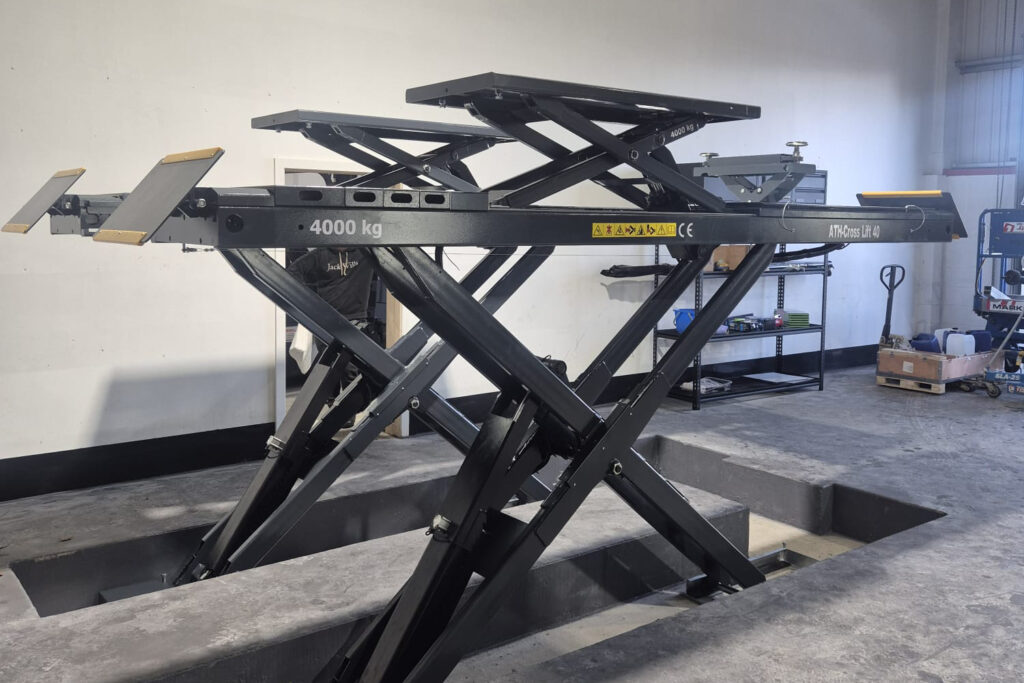
Choosing the right scissor lift is one of the most important decisions a workshop can make regarding garage equipment. A good vehicle lift does far more than raise a car or van off the ground. It shapes how quickly technicians can work, how safely they can inspect vehicles, how much space is available in the bay and what type of jobs the business can take on.
For garages, MOT stations, tyre bays, bodyshops and light commercial vehicle workshops, the right car scissor lift can make daily work smoother and safer. The wrong lift can have the opposite effect. It can restrict access, slow down repairs, limit the types of vehicles you can accept and create headaches when it comes to installation, servicing or MOT approval.
A scissor lift is popular because it provides workshops with a compact, professional, and versatile lifting solution. Unlike a 2-post lift or 4-post lift, a vehicle scissor lift uses a crossed-arm mechanism underneath the platform. The vehicle is lifted vertically, usually by a hydraulic system, with the “scissor” structure opening and closing as the platform rises and lowers. This design is one of the reasons scissor lifts are often chosen where space, workflow and vehicle access matter. Within the automotive industry, there are three main types: recessed scissor lifts, surface-mounted scissor lifts and mobile scissor lifts.
At V-Tech Garage Equipment, we supply a wide range of workshop equipment and services, including vehicle lifts, MOT bays, and scissor lifts, with support for delivery, installation, finance, servicing, and maintenance. That makes the buying decision easier, but it still helps to understand what to look for before you enquire.
This guide explains how to choose the right scissor lift for cars and vans, which specifications matter, which type of lift suits different workshop layouts, and what UK garages need to consider before ordering.
What is a Scissor Lift?
A scissor lift is a type of vehicle lift that raises a car or van using a set of crossed steel arms beneath the lifting platform. As the lift rises, the arms pivot and extend in a controlled vertical motion. When the lift lowers, the arms fold back down into a more compact position.
Most professional garage scissor lifts use hydraulic power. The hydraulic system drives the lift upward, while safety systems help control it during use and descent. The crossed arm design is often referred to as a pantograph mechanism. On a workshop vehicle lift, this provides the lift with strength, vertical movement, and a relatively compact footprint.
In practical terms, a scissor lift gives technicians a platform-style lift without large side posts. This can be a major advantage in workshops where space is tight or where door opening, bodywork access and bay layout are important. Scissor lifts are either drive-on or drive-over, making them useful for servicing, MOT testing, inspections, tyre and brake checks, suspension checks, wheel alignment, and general mechanical work.
The best scissor lift for your workshop depends on the vehicles you lift, the work you do and the physical space available. A tyre bay may want quick lifting and wheel-free access. An MOT station will need a DVSA-compliant MOT scissor lift with the right platform dimensions, headroom, play-detector compatibility, and jacking equipment. A garage working on vans will need to pay close attention to safe working load, platform length, vehicle height and weight distribution.
Why Scissor Lifts are Popular in Modern Garages
Scissor lifts are widely used because they solve many common workshop problems. They save space, lift quickly, provide a stable working platform, and can often be installed in areas where a traditional 4-post or 2-post lift is not ideal.
A key advantage is the absence of side posts. With no posts near the vehicle doors, technicians have better side access to interiors, sills, trim, paintwork, and lower body areas. This is particularly useful for bodyshops, detailing centres and workshops where getting around the vehicle matters as much as getting underneath it.
Scissor lifts are also efficient for high-volume work. On many drive-on models, the technician can position the car or van on the platforms and raise it without setting four separate swing arms. That can save time across repeat jobs such as inspections, servicing, tyre work and fleet maintenance. Depending on the lift and the vehicle, scissor lifts in workshops can offer easier access to the underside, enhanced stability, and less technician fatigue as key advantages.
For smaller premises, a compact garage scissor lift can be the difference between adding a lifting bay and having no practical space for one. Surface-mounted models can help avoid most groundwork requirements. Recessed scissor lifts sit flush with the floor when lowered, which keeps the bay neater and easier to move through. Mobile scissor lifts can suit lighter-duty tasks or flexible workshop layouts.
That said, a scissor lift is not automatically the answer for every garage. Some models limit access to parts of the vehicle because the lifting mechanism is located under the platform. That may make certain exhaust, prop shaft, transmission or centre tunnel jobs less convenient than they would be on a 2-post lift. The right choice depends on the balance of jobs you carry out most often.
The Main Types of Scissor Lift
There are three main categories to consider when choosing a car scissor lift or van scissor lift: recessed, surface-mounted and mobile. Each has strengths, trade-offs and installation requirements.
Recessed Scissor Lift
A recessed scissor lift is installed in prepared floor recesses so that the platforms sit flush or near-flush with the workshop floor when lowered. This is often the cleanest option for a professional workshop because the bay remains open and easy to drive across when the lift is not in use.
The main benefit is workflow. A flush floor makes vehicle positioning easier, improves access around the bay and reduces trip hazards. It is also useful in MOT bays and alignment bays where a neat, accurate platform position matters.
The trade-off is groundwork. A recessed vehicle scissor lift typically requires floor preparation, precise measurements, drainage considerations, electrical or hydraulic routing, and professional installation. For new builds or workshop refurbishments, this can be planned from the beginning. For existing garages, the extra groundwork needs to be included in the budget and schedule.
A recessed scissor lift is often the preferred option when the workshop wants a premium installation, durable daily use and a bay that looks and functions professionally.
Surface-Mounted Scissor Lift
A surface-mounted scissor lift sits on top of the existing workshop floor. It can be easier and quicker to install than a recessed model because less civil work is usually required. This makes it attractive for garages upgrading an existing bay, businesses that want to avoid cutting into the floor, or sites where recessing is not practical.
The main advantage is convenience. You can add professional vehicle-lifting capability without the same level of groundwork required for a recessed installation. Surface-mounted scissor lifts can be strong, stable and suitable for regular car and van lifting, provided the lift specification and floor condition are right.
The trade-off is drive-over height. Because the lift sits above the floor, low cars may need long run-up ramps or a low-profile lift design. Workshops that regularly service sports cars, modified vehicles, or low-clearance vehicles should check the minimum lowered height before buying.
A surface-mounted scissor lift can be a sensible choice for general repair garages, tyre bays and workshops that want a strong lift without major building work.
Mobile Scissor Lift
A mobile scissor lift is designed for flexibility. It can be moved around the workshop and used where a permanent installation is not required. These lifts are generally better suited to lighter-duty work than heavy fixed lifts, although exact capability depends on the model.
The attraction is obvious. A mobile car scissor lift can support occasional use, smaller garages, valeting areas, hobby use or workshops where the layout changes. It can also be useful as an extra lifting option when the main bays are busy.
The limitation is capacity and working height. Mobile scissor lifts may not offer the same lifting height, platform size, or safe working load as fixed, professionally installed scissor lifts. If you regularly lift vans, SUVs, EVs or fully loaded vehicles, a fixed lift with the correct capacity will usually be the better long-term investment.
A mobile scissor lift is best viewed as a versatile tool for tyre bays, fast-fit operations, and bodyshops, rather than as a replacement for a service lift.
Choosing a Scissor Lift for Cars
For a garage mainly lifting cars, the first question is what type of work the lift must support. A car lift for general servicing has different priorities from a tyre bay lift, a bodyshop lift or an MOT lift.
For servicing, you need reliable lifting height, good underside access, stable platforms and a safe working load that comfortably covers the vehicles you accept. Most modern cars are heavier than older models, especially hybrids and EVs, so it is worth thinking beyond the smallest hatchbacks. If your workshop handles SUVs, executive vehicles or electric cars, do not choose a lift based only on traditional car weights.
For tyre and brake work, wheel-free access matters. Some scissor lifts raise the vehicle by its wheels on long platforms. That is useful for inspections and general servicing, but wheel removal may require integrated jacking beams, secondary lifting tables or suitable jacking equipment. If tyres, brakes and suspension are core revenue lines, make sure the lift supports these jobs efficiently.
For bodywork, detailing and smart repair, side access can be more important than full underbody access. A scissor lift with no side posts can be ideal because technicians can move around doors, sills and lower panels more freely. This helps with polishing, wrapping, repairs and paint preparation.
For low cars, check the minimum platform height. A low-profile or recessed scissor lift may be needed where vehicles have limited ground clearance. Also check ramp approach angles, platform length and whether extensions are available.
A car scissor lift should be chosen for the cars you actually see every week, not just the cars you would like to see. Look at your job cards, vehicle mix and future plans before deciding.
Choosing a Scissor Lift for Vans
Lifting vans adds another layer of decision-making. Vans can be longer, taller and heavier than cars. They may carry racking, tools, parts or stock. Their weight distribution can vary significantly depending on whether they are empty, partially loaded or fully loaded.
For van lifting, a safe working load is critical. The lift must be rated for the heaviest vehicles you plan to raise, with a sensible safety margin. Do not assume that a car lift is automatically suitable for vans just because a van can physically fit on the platforms. Check the rated capacity, platform length, lifting points, wheelbase compatibility and manufacturer guidance.
Platform length is also important. Short platforms may not support longer wheelbase vans properly. A light commercial vehicle lift needs to accommodate the wheelbases and overhangs of the vehicles you work on. If the workshop services tradespeople, couriers, local fleets or camper conversions, this should be checked carefully.
Height is another factor. A van raised on a scissor lift needs enough roof clearance, especially in a building with heaters, lighting, beams, doors or mezzanine areas. Class 7 MOT bays have stricter headroom requirements than general workshop use, but even non-MOT van servicing needs a practical clearance check.
Vans may also change the business case. A workshop that can lift vans safely can attract fleet maintenance and trade customers, as well as higher-value jobs. But only if the equipment is specified properly. If vans are part of your growth plan, discuss them at the buying stage rather than treating them as an afterthought.
Scissor Lift or 2-Post Lift?
A 2-post lift is a workshop favourite because it gives excellent access to the underside of the vehicle and leaves wheels hanging free. It is often ideal for mechanical repairs, clutch work, exhausts, suspension work, and jobs that require full underbody access.
A scissor lift is often stronger in terms of space, speed, and platform stability. Many models are easier to drive onto and do not require arm positioning in the same way that a 2-post lift does. They also keep the sides of the bay clear of posts, which helps in tighter workshops or where door access matters.
The choice comes down to the work. If the garage carries out heavy mechanical repairs all day, a 2-post lift may still be the best main lift. If the garage needs a compact, drive-on vehicle lift for servicing, inspections, tyres, MOT work or mixed tasks, a scissor lift can be the better fit.
Many successful workshops use both. A 2-post lift handles deep mechanical work while a scissor lift handles fast-moving service, MOT or inspection tasks.
Scissor Lift or 4-Post Lift?
A 4-post lift gives a stable drive-on platform and is often used for MOT testing, alignment and long-duration work. It can be a strong choice when platform length, vehicle stability and straightforward drive-on operation matter.
A scissor lift can offer similar drive-on convenience while taking up less visual and physical space. It can also help where workshop width is restricted, although platform length and scissor placement still need to be checked. When choosing an MOT lift, remember that 4-post and scissor lifts are both platform lifts. Width restrictions may make a scissor lift attractive, but they also limit platform length options.
A 4-post lift may offer a broader capacity range and slightly easier access to the undercarriage. A scissor lift may suit workshops that want a cleaner bay, fewer posts and better use of space.
For MOT stations, the decision must be based on DVSA requirements, available bay dimensions, and the class of vehicle being tested. For general servicing, the decision is more about workflow and the jobs that generate the most profit.
Scissor Lifts for MOT Bays
If you are choosing a scissor lift for an MOT bay, the lift is not just a workshop tool. It is part of a regulated test lane. That means the lift, jacking equipment, layout, headroom and associated MOT equipment need to match the relevant requirements.
For Class 4 MOT testing, DVSA guidance states that the dimensions in the test bay section are minimum requirements and that the equipment or layout selected can affect which vehicles can be tested. It also advises applicants not to proceed with building alterations or equipment purchases until they receive written approval in principle (AIP) from DVSA.
For Class 4, a wheel-supporting platform lift must meet requirements including platform length, lift height, platform spacing, and a clearly marked safe working load. DVSA guidance lists a minimum platform length of 3.9m, a lift surface that can be raised at least 1.5m above the floor, and a safe working load of at least 3 tonnes, along with specific requirements for jacking equipment.
For Class 7, the requirements differ because the vehicles are larger. DVSA guidance sets out minimum test bay size, entrance and exit dimensions, headroom and lift requirements. It states that Class 7 lift headroom must be at least 4.8m, measured from the platform surfaces when fully lowered, and that wheel-supporting platform lifts must have platforms at least 4.8m long, platform surfaces capable of being raised at least 1.4m, and a clearly marked safe working load of at least 3.5 tonnes.
Capacity and Safe Working Load
Safe Working Load, often shown as SWL, is one of the most important scissor lift specifications. It tells you the maximum load the lift is designed to handle. The lift must be rated for the vehicles you intend to raise.
For a car workshop, think about the heaviest cars, SUVs and EVs you regularly service. For a van workshop, consider long-wheelbase vans, loaded service vans, and fleet vehicles. For MOT use, check the minimum requirements for the class of testing, but also think about your actual customer base.
The HSE warns that working under vehicles can be dangerous when lifting equipment is poorly maintained, incorrectly used or overloaded. It specifically advises users not to exceed the rated capacity of lifting equipment and to make sure vehicles are properly supported.
A lift with too little capacity is not a bargain. It is a restriction. It can limit bookings, create safety concerns, and reduce technician confidence. A properly rated vehicle scissor lift provides the workshop with greater flexibility and supports future growth.
Platform Length, Width, and Vehicle Access
Platform dimensions decide which vehicles the lift can handle comfortably. This is especially important for vans, SUVs, longer-wheelbase cars, and MOT lanes.
A platform that is too short can make positioning awkward. A platform that is too narrow can make loading uncomfortable. A lift that does not fit within your wheelbase range can limit the vehicles you can accept.
When comparing scissor lifts, check the full platform length, usable platform length, overall width, distance between platforms and approach ramp design. For MOT lifts, check the relevant DVSA requirements. For general workshop lifts, check your vehicle mix.
Also, think about your technician, not just the vehicle. Can they walk around the lift safely? Can doors be opened? Can tool trolleys move through the bay? Can the technician access the areas they need without having to work awkwardly?
A productive workshop bay is not just about lifting height. It is about comfortable, repeatable movement around the vehicle.
Full Height, Mid-Rise or Low-Rise Scissor Lift?
Just like a pair of jeans, scissor lifts come in different lift heights. The right height depends on the job.
A full-height scissor lift allows a technician to stand beneath the vehicle. This is the best choice for regular servicing, inspections, MOT work and general repairs.
A mid-rise scissor lift raises the vehicle high enough for many tyre, brake, body, and service tasks, but not high enough for full standing access to the underbody. It can be useful where ceiling height is limited or where the work is mainly around wheels and lower body panels.
A low-rise scissor lift is generally used for quick tasks, detailing, tyre work, bodyshops, or small garages where full-height lifting is not required. These are used as an alternative to lifting with trolley jacks and axle stands. It is compact and convenient, but it is not a replacement for a full workshop lift.
Before buying, decide whether technicians need to stand under vehicles, sit at wheel height or simply raise vehicles enough for access. Buying too little lifting height can limit your services. Buying more than you need can take up budget that may be better spent on jacking equipment, installation or servicing.
Installation Requirements
A scissor lift must be installed correctly. This includes checking the floor, power supply, hydraulic or pneumatic requirements, drainage, access, clearances and the intended use of the bay.
Surface-mounted lifts may not need groundwork, but the concrete still has to be suitable. Recessed lifts need accurate civil work. MOT lifts need even more care because layout and equipment approval matter.
Power supply should be checked before ordering. Some vehicle lifts can run on single-phase power, while others may need a three-phase supply. Some workshop equipment also requires compressed air. Confirm these details before planning installation dates, especially if electrical upgrades are needed.
Professional installation is also important for training. We offer delivery and installation support, which includes on-site training to ensure technicians are comfortable and confident using the equipment. That is worth building into the project, particularly when the lift will be used by multiple technicians.
A good installation should leave the workshop with more than a working lift. It should leave the team with confidence, clear operating procedures and a plan for ongoing maintenance.
Servicing and Maintenance
A scissor lift is a long-term investment. Like any piece of workshop equipment, it needs maintenance to perform reliably.
Preventative maintenance helps reduce downtime, protect safety systems, spot wear and keep the lift operating smoothly. Checks may include hydraulic components, locks, hoses, pivots, platforms, controls, electrical systems, fixings and general condition. The exact schedule should follow manufacturer guidance and the level of use in the workshop.
A busy MOT bay or tyre shop may use a lift dozens of times a day. A smaller repair garage may use it less often. Either way, waiting for a breakdown is usually more expensive than planned servicing.
At V-Tech Garage Equipment, we recommend service and maintenance packages to help keep equipment performing throughout the year. For a lift that sits at the centre of daily revenue, this makes commercial sense. If the lift is down, the bay is down.
When comparing scissor lift prices, factor in maintenance support in your decision. Ask about service availability, spare parts, response times, and post-installation support. The cheapest lift on day one may not be the cheapest lift over five years.
Common Mistakes When Buying a Scissor Lift
- Don’t buy only based on lifting capacity. Capacity matters, but it is only one part of the decision. Platform length, lifting height, access, installation, bay dimensions and service support all matter too.
- Don’t forget vans? A lift that suits small cars may not suit long-wheelbase vans, loaded trade vehicles, or heavier modern SUVs. If you want to grow into van servicing, choose a lift that supports that plan.
- Don’t ignore the floor and building requirements. A surface-mounted scissor lift still needs a suitable floor. A recessed scissor lift needs proper groundwork. A full-height lift needs enough roof clearance. A Class 7 MOT lift needs far more headroom than a standard car lift.
- Don’t underestimate the need for jacking. Platform lifts are excellent, but wheel-free work may require jacking beams or the use of integrated secondary lifting. If your team spends all day on brakes, tyres and suspension, this is not optional.
- Don’t treat installation and training as extras. Correct installation and proper operator training are central to safe use.
- Don’t fail to plan for servicing. Every lift needs maintenance. A workshop should know who will service it, how often it will be checked and what to do if a defect is found.
What to Ask Before Buying
Before ordering a scissor lift, ask the following questions:
- What vehicles will we lift most often?
- Will we lift vans, SUVs, EVs or loaded vehicles?
- What is the heaviest vehicle we realistically expect to work on?
- Do technicians need full standing height under the vehicle?
- Do we need wheel-free lifting for tyres, brakes or suspension?
- Is this lift for general servicing, MOT testing, bodywork, alignment or mixed use?
- Do we have the correct floor depth, concrete condition and power supply?
- Would a recessed or surface-mounted installation suit the building better?
- Do we need a low-profile model for sports cars or lowered vehicles?
- Will the lift layout affect other equipment such as brake testers, headlamp aligners, wheel play detectors or wheel aligners?
- Who will install, train, service and inspect the lift?
- For MOT stations, has the layout been checked against the relevant DVSA requirements before purchase?
These questions help turn a broad product search into a clear specification. That is how you avoid buying a lift that looks right online but fails to suit the bay in practice.
The Business Case for the Right Scissor Lift
A scissor lift is not just a cost. It is a revenue tool.
The right lift can help a garage increase throughput by making inspections, servicing and repairs quicker. It can help technicians work more comfortably, reduce time spent positioning equipment and make better use of tight workshop space. For MOT stations, the right lift can support a compliant and efficient test lane. Van workshops can open the door to more fleet work and light commercial servicing.
It can also improve customer perception. A clean, well-planned lifting bay signals professionalism. Customers may not know the technical specification of your vehicle scissor lift, but they notice when a workshop looks organised, modern and safe.
For independent garages, the right lift can create a competitive advantage. It helps the team take on more work, move jobs through the workshop faster and reduce bottlenecks. For growing workshops, it can be part of a larger plan that includes MOT bay equipment, wheel alignment, tyre equipment, brake testing and diagnostic tools.
Here at V-Tech Garage Equipment, we are a one-stop shop for garage equipment, including vehicle lifts, MOT bays, tyre changers, wheel balancers, brake testers, jacking beams, and more. That wider equipment view matters because a lift rarely works in isolation. It sits inside a full workshop system.
Save Space, Improve Efficiency
The best scissor lift is not simply the biggest, cheapest or most powerful model. It is the lift that matches your vehicles, your building, your technicians and your business plan.
For cars, focus on access, lifting height, low-profile needs and the type of work you do most often. For vans, pay close attention to safe working load, platform length, roof clearance and wheelbase. For MOT bays, prioritise compliance and layout. For all workshops, insist on professional installation, training, maintenance and thorough examination.
A well-chosen car and van scissor lift can transform a workshop. It can save space, improve efficiency, make daily work safer and support a wider range of profitable services. A poorly chosen lift can hold the business back.
Before you buy, speak to a garage equipment specialist who can assess your workshop, understand your vehicle mix, and recommend the right scissor lift for your bay. At V-Tech Garage Equipment, we can help with scissor lifts, vehicle lifts, MOT bay equipment, and provide nationwide installation, servicing, and ongoing workshop support.
Call us today on 0208 498 1288 or email sales@v-techuk.com, and one of our team will be happy to help.
FAQs
Are scissor lifts good for garages?
Yes, scissor lifts are a strong option for many garages because they are compact, stable and versatile. They are especially useful for servicing, inspections, MOT bays, tyre work, bodywork and workshops where space is limited. The key is choosing the right type, capacity and platform size for your vehicles.
Can a scissor lift lift vans?
Some scissor lifts can lift vans, but not all. You need to check safe working load, platform length, wheelbase suitability, lifting height and roof clearance. If you work on light commercial vehicles regularly, choose a scissor lift designed for vans rather than assuming a car lift will be suitable.
What is better, a scissor lift or a 2-post lift?
A 2-post lift is often better for deep mechanical work and full access to the underside. A scissor lift is often better for space-saving, drive-on convenience, servicing, inspections, MOT, or tyre bay use. Many workshops benefit from having both.
What is better, a scissor lift or a 4-post lift?
A 4-post lift can be excellent for MOT testing, alignment and stable platform lifting. A scissor lift can offer similar drive-on convenience with fewer posts and a more compact bay. The right choice depends on workshop layout, vehicle types, MOT requirements and the work being carried out.
Do scissor lifts need servicing?
Yes. Scissor lifts should be serviced and maintained according to manufacturer guidance and workshop usage. They also need appropriate inspections and thorough examinations by competent people where required. This helps protect safety, reduce downtime and keep the lift working correctly.
Is a recessed scissor lift better than a surface-mounted scissor lift?
A recessed scissor lift gives a cleaner, flush-floor installation and is often ideal for professional bays, MOT lanes and new workshop projects. A surface-mounted scissor lift is usually easier to install and may be better for existing workshops where groundwork needs to be kept to a minimum. Both can be excellent when specified correctly.
What should I check before installing a scissor lift?
Check vehicle types, safe working load, lifting height, platform dimensions, ceiling height, floor condition, power supply, bay layout, jacking requirements and servicing support. For MOT bays, check the relevant DVSA requirements before ordering equipment or starting building alterations.