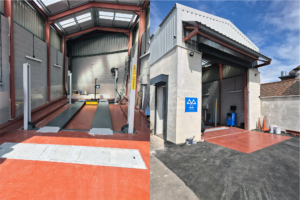
A 2-post lift is one of the most practical and profitable pieces of garage equipment a workshop can install. For many independent garages, tyre shops, repair centres, bodyshops and service bays, it gives technicians fast access to the wheels, underside, suspension, brakes, exhaust, driveline and side areas of a vehicle. Unlike axle stands or trolley jacks, a properly installed 2-post car lift is designed to raise a vehicle to a comfortable working height, helping technicians work more efficiently and with better access around the vehicle.
Choosing the right 2-post lift, however, is not simply a case of picking the first model that fits the budget. The best lift for your workshop depends on the vehicles you service, the space you have available, the concrete floor specification, the ceiling height, the power supply, the type of work you carry out, and the long-term support you expect after installation. A 2-post lift is lifting equipment, so safety, operator training, servicing, inspection and compliance all need to be part of the buying decision.
V-Tech Garage Equipment supplies and installs premium-quality garage equipment nationwide, including vehicle lifts and a wide range of workshop equipment, making the lift selection process easier for businesses that need practical advice before committing to a new workshop lift.
What is a 2-Post Lift?
A 2-post lift, sometimes called a two-post car lift, 2-post ramp, or 2-post hoist, uses two upright columns with lifting arms positioned beneath the manufacturer-approved lifting points of the vehicle. The vehicle is raised from its chassis or jacking points, leaving the wheels hanging free and giving the technician clear access to many key service and repair areas.
A typical 2-post car lift consists of two steel posts or columns, lifting arms, lifting pads, a drive system, safety locks and a synchronisation system. In many designs, cables, chains, or other synchronising mechanisms help both sides rise and lower evenly, so that the vehicle remains level during the lift cycle.
That combination of access and compact footprint is why 2-post lifts remain so popular. They take up less room than many 4-post lifts, they allow the arms to be tucked away when not in use, and they make many common workshop jobs quicker. For servicing, mechanical repairs, wheel removal, brake work, suspension work and general inspection, a good 2-post vehicle lift can become one of the hardest-working pieces of equipment in the building.
Why 2-Post Lifts are so Popular in UK Workshops
The main attraction of a 2-post lift is access. Once the vehicle is positioned correctly and raised safely, the technician can move around the vehicle without platforms blocking the wheels. That is especially useful for brake work, tyre and wheel removal, suspension checks, steering components, exhaust repairs, underbody inspection and many routine service tasks.
A 2-post lift can also improve workshop efficiency. Instead of spending time raising a vehicle with jacks, positioning stands and working at ground level, technicians can bring the vehicle up to a more comfortable height and get straight to the job. Faster access can reduce labour time, improve job flow and help workshops turn vehicles around more quickly. One of the key highlights is the efficiency benefit of easier underside access, as technicians can diagnose and repair problems faster than when working from a creeper or a basic support method.
Cost is another reason many garages choose a 2-post lift. Compared with some larger lift types, a 2-post ramp is often a cost-effective option for workshops that need full-rise lifting but lack the space or budget for a larger platform lift. It can deliver a strong lifting capacity and good access while keeping the bay layout relatively simple. The total cost, however, must include more than the lift itself. Groundworks, electrical supply, delivery, installation, staff training, servicing and statutory examinations all need to be included in the budget.
2-Post Lift vs 4-Post Lift vs Scissor Lift
Before choosing a 2-post lift, it helps to compare it with other common vehicle lift types.
A 4-post lift uses four columns and runways or platforms. The vehicle is driven onto the platforms, then lifted. This can be ideal for MOT bays, wheel alignment, storage, larger vehicles and situations where the vehicle needs to remain supported by its wheels. A 4-post lift usually has a larger footprint, but it can feel familiar to drive onto and can be well-suited to heavier or longer vehicles.
A scissor lift uses a scissor-style lifting mechanism, often with platforms or lift tables. Depending on the model, it may be recessed into the floor or surface-mounted. Scissor lifts can be excellent in tight spaces, where a ‘clear floor’ is desired, or where a workshop needs a neat installation. Some are designed for MOT use, some for tyre and service work, and some for bodyshop or quick-service operations.
A 2-post lift uses two columns and adjustable arms. It is generally chosen when a workshop needs good all-round access, especially to the wheels and underside. Compared with a 4-post lift, it takes up less floor space and gives excellent wheel-free access. Compared with some scissor lifts, it may provide better access to the vehicle’s centre underside, depending on the model.
The right answer depends on the work you do. For general mechanical repairs, servicing, brakes, clutches, suspension and inspection, a 2-post lift is often the most versatile choice. For MOT testing, alignment, vehicle storage, larger vehicles or low-profile specialist cars, another lift type may be more appropriate. Remember to consider factors such as price, lifting capacity, floor space, ceiling height, and vehicle type when comparing vehicle lifts.
Start with the Vehicles You Lift Most Often
The first buying question is simple: what vehicles will the lift handle every day?
A garage working mainly on small cars and family hatchbacks may not need the same lift as a workshop servicing long-wheelbase vans, pick-ups, electric vehicles, camper conversions or heavier commercial vehicles. The stated lifting capacity of the ramp must be suitable for the heaviest vehicles you plan to lift, but capacity is only part of the decision. You also need to consider wheelbase, lifting point positions, weight distribution, arm reach and how the vehicle sits between the posts.
Do not choose a 2-post car lift based only on the average vehicle you service. Choose it around the heaviest and most awkward vehicle that realistically comes into the workshop. If you regularly work on vans, check whether the lift has the capacity, column height, arm configuration and pad options to handle them safely. If you work on electric vehicles, remember that battery placement can affect weight distribution and lifting procedures. If you handle low sports cars, check whether the arm profile and pad height will allow safe access to the lifting points.
For mixed workshops, a higher-capacity 2-post lift can be a good investment, but the capacity still needs to be matched to the correct installation and floor specifications. A lift that is technically rated for the vehicle is not the right lift if the site cannot safely support it.
Symmetric or Asymmetric 2-Post Lift?
One of the most common choices is between a symmetric and asymmetric 2-post lift.
A symmetric 2-post lift basically has arms of equal reach, with the vehicle positioned more centrally between the posts. This can be useful for many general workshop tasks and can provide balanced support when the vehicle is correctly positioned. It is a common layout for workshops that work on a broad mix of vehicles and want a straightforward lifting setup.
An asymmetric 2-post lift features one arm pair with a shorter reach than the other, allowing the vehicle to sit slightly further back. This design makes opening doors easier, as they are less likely to hit the columns. Such a setup is particularly beneficial in busy service bays where technicians need frequent access to the vehicle, such as connecting diagnostic tools, checking mileage, moving seats, releasing the bonnet, or performing interior work. Remember, asymmetric lifts position more weight on the rear arms, which facilitates better door access.
The choice is not about one being universally better. It is about how the lift will be used. For tight workshops where door access is a daily frustration, an asymmetric 2-post lift can be a smart choice. For heavier vehicles or workshops that prefer central vehicle positioning, a symmetric lift may be more suitable. A site visit and vehicle mix review can help narrow this down quickly.
Check Lifting Capacity Carefully
Lifting capacity is one of the most searched-for 2-post lift specifications, but it is also one of the easiest to misunderstand. A lift rated at 4 tonnes, for example, does not mean every 4-tonne vehicle can automatically be lifted in every workshop. The vehicle must be positioned correctly, the arms must reach the correct lifting points, the weight distribution must be safe, the floor must meet specifications, and the lift must be installed, maintained and operated correctly.
When comparing lifts, look beyond the headline capacity. Check the safe working load, arm capacity, minimum and maximum arm reach, pad height, column height, overall width, lifting height and drive-through clearance. A lift that looks good on paper may not suit wide vans, long-wheelbase vehicles or low-profile cars. Likewise, a lift with impressive capacity may be unnecessary if the workshop only services light passenger cars.
HSE guidance warns that lifting equipment should not exceed its rated capacity and that lifting points must be correct for the vehicle. This is not just a compliance point. It is a practical safety rule that should shape the whole buying process. The right 2-post lift is the one that safely suits the work you actually do.
Measure Your Workshop Properly
A 2-post lift needs more than enough room for the columns. You need enough space for the lift, the vehicle, the doors, technician movement, toolboxes, fume extraction, lighting, diagnostic equipment and safe access routes. Ceiling height is particularly important because the raised vehicle, the lift posts and the lifting height must all be considered together.
A full-rise 2-post car lift usually requires a substantial ceiling height, and most guidance recommends that a standard full-rise installation needs at least 3.5m, depending on the lift and the vehicle. Always check the specific lift model and site conditions rather than relying on a general figure. A high-roof van on a 2-post ramp needs much more clearance than a small hatchback.
Width also matters. There must be enough room to open doors, move around the vehicle, position equipment and avoid creating pinch points. Depth matters too, especially when working on long vehicles or when the lift is close to doors, walls or other bays. The lift must improve workflow, not create a bottleneck.
A professional site survey can identify these issues before money is spent. That is especially important for workshops planning to add more than one ramp, add an MOT bay, redesign a workshop, or install a lift in an older building.
Concrete Floor Requirements are Critical
The floor is one of the most important parts of a 2-post lift installation. A 2-post lift is anchored into the concrete floor, so the concrete must be strong enough, thick enough, level enough and in suitable condition for the specific lift and loads involved.
At V-Tech Garage Equipment, we advise verifying that the concrete surface is suitable and level before installation. We can’t emphasise enough that floor depth is crucial for a safe setup. Generally, a concrete depth of 150mm to 250mm is recommended for installing a 2-post lift, though thinner concrete may not withstand the forces involved. Ultimately, the precise requirements should always follow the lift manufacturer’s specifications and be assessed by a qualified installer based on the site conditions.
HSE guidance is clear that the floor and fixings should meet the lift manufacturer’s specification, and that specialist advice should be obtained where there is doubt. It also states that, once installed, the lift must be tested by a competent person before use, with a certificate issued.
This is why buying a 2-post lift as a simple delivered product is rarely the best route for a professional garage. Installation quality matters. Anchor bolts, concrete condition, floor levels, power supply, post alignment and final testing all affect safety and long-term performance.
Choose the Right Power Supply
Before ordering a 2-post lift, check the electrical requirements. Some lifts may be available in single-phase or three-phase versions, while others may require a specific supply. The workshop must have the correct power available, and any electrical work should be carried out by a competent, registered electrician.
It is worth checking this early, as electrical upgrades can affect the project’s cost and timeline. A lift that appears good value may become less attractive if the workshop needs additional electrical work, distribution changes or cable routing to support it. On the other hand, properly planning the power supply can help future-proof the workshop for additional ramps, compressors, tyre equipment, diagnostic tools, or EV-related equipment.
When comparing 2-post vehicle lifts, ask what power supply is required, where the control unit will be located, whether the lift has overhead or floor-level connections, and how the installation will fit into the wider workshop layout.
Safety Features to Look For
A modern 2-post lift should be designed with safety in mind, but buyers still need to understand which features matter. Look for strong arm locking systems, reliable safety locks, quality lifting pads, clear controls, emergency lowering arrangements, synchronisation between posts and robust mechanical construction.
Arm locks are especially important. HSE guidance specifically states that, for 2-post lifts, workers should ensure arm locks are fully engaged and secure and that lifting pads are correctly positioned before raising the vehicle to full height. Damaged or missing lifting pads should be replaced before they become unsafe, and operators should understand how vehicle balance changes with different vehicle types or when major components, such as a gearbox, are removed.
Do not treat safety features as optional extras. They are part of a sound business case. A safe lift protects technicians, vehicles, customers, and the workshop’s reputation. It can also reduce downtime, prevent avoidable damage and make daily operation more consistent.
Installation Should Be Professional, Tested, and Documented
A 2-post lift should be installed by trained professionals who understand lift positioning, floor requirements, fixings, levelling, electrical connection, commissioning and testing. Poor installation can undermine even a high-quality lift.
Before installation, the site should be checked. That means measuring the bay, confirming ceiling height, inspecting the concrete, confirming the power supply, checking access for delivery and agreeing on the final position. During installation, the lift should be assembled and fixed in line with the manufacturer’s instructions. After installation, it should be load tested before use.
HSE guidance states that lifting equipment must be correctly installed, that the floor and fixings must meet the manufacturer’s specification, and that the lift must be tested before it is used by a competent person. It also advises regularly checking the fixing bolts with a torque wrench to make sure they remain tight.
The paperwork matters as well. Keep installation records, certificates, manuals, service records and examination reports together. This makes future servicing easier and helps demonstrate that the workshop is properly managing lifting equipment.
Operator Training is Part of the Purchase
A 2-post lift is only safe when the operator understands how to use it correctly. Training should cover vehicle positioning, identifying lifting points, arm placement, pad use, arm lock engagement, load limits, raising procedure, stability checks, lowering procedure, daily checks and what to do if something does not look right.
Technicians should know not to overload the lift, not to guess lifting points, not to use damaged pads, not to bypass safety devices, and not to continue using equipment that appears defective. They should also understand how vehicle balance can change when heavy components are removed. Removing an engine, gearbox, axle or battery pack can change the centre of gravity, so additional support may be needed.
HSE guidance emphasises the need for lifting equipment to be maintained and for operators to be trained to use it correctly. A good lift supplier should be able to advise on safe use at handover, but the workshop should also build lift checks into its own safe systems of work.
Servicing, Maintenance, and Thorough Examination
A 2-post lift is not a fit-and-forget purchase. It needs routine maintenance, in-house checks and periodic thorough examination by a competent person.
PUWER applies to work equipment and covers areas such as inspection, maintenance, training and competence. HSE describes PUWER as applying to people and companies that own, operate or have control over work equipment. The regulations also require work equipment to be maintained in efficient working order and in good repair, with maintenance logs kept up to date where machinery has them.
LOLER is also central to lifting equipment. HSE explains that safe lifting operations depend heavily on the continued safety of lifting equipment and accessories, and that lifting equipment should be checked and maintained to remain safe for use. A thorough examination under LOLER is a systematic, detailed assessment of equipment and safety-critical parts by a competent person, followed by a written report.
For vehicle lifts, HSE recommends a thorough examination every six months, while making it clear that this is not a replacement for regular in-house checks and maintenance. In practice, that means a workshop should have a routine for daily or pre-use checks, planned servicing and statutory examination. All three have a role.
Do Not Ignore the Total Cost of Ownership
When comparing 2-post lift prices, it is tempting to focus on the purchase price. That can be misleading. The true cost of a 2-post lift includes the lift, delivery, installation, electrical work, any groundworks, training, accessories, servicing, thorough examinations, repairs and downtime if the lift is not supported properly.
A cheaper lift may not be cheaper over its working life if parts are difficult to obtain, support is poor, the warranty is limited, or the equipment is not well matched to the workshop. Likewise, a premium lift may provide better value if it improves productivity, reduces downtime and gives technicians more confidence.
Before buying, ask these questions:
- What vehicles can it lift safely?
- Does the arm reach suit the vehicles we service?
- Will it fit our ceiling height and bay width?
- Does our concrete floor meet the required specification?
- Is the power supply suitable?
- Who will install and test it?
- What warranty is included?
- What servicing is available?
- Are spare parts available?
- Who will carry out thorough examinations?
- What training will operators receive?
That list may feel longer than expected, but it is much cheaper to ask these questions before installation than to discover problems afterwards.
Is a 2-Post Lift Suitable for Every Garage?
A 2-post lift is ideal for many workshops, but it is not automatically right for every site. A garage with limited ceiling height, poor concrete, very low-profile vehicles, heavy vans or MOT testing requirements may need a different lift type or additional equipment.
For low-profile vehicles, arm clearance can be an issue. Some vehicles sit too low for standard arms and pads to reach the lifting points easily. Low-profile arms or alternative lifting equipment may be needed.
For long-term vehicle storage, a 4-post parking lift may be more suitable because the vehicle sits on platforms with its wheels supported. For MOT bay planning, the correct equipment depends on the class of testing, layout and DVSA requirements. The current MOT testing guide is maintained by DVSA and covers how MOT test stations are administered and what test stations need to know.
For general servicing and repair, however, a 2-post lift remains one of the most useful workshop lift options. The key is choosing one that suits the site and the work.
A Practical 2-Post Lift Buying Checklist
A good 2-post lift buying process should start with the workshop, not the brochure.
- List the vehicles you work on most often, including the heaviest, longest and lowest vehicles. Include vans, electric vehicles and specialist vehicles if they are part of your workload.
- Measure the workshop. Check ceiling height, bay width, bay depth, door clearance, lighting, power supply and access routes. Think about how technicians will move around the vehicle once it is raised.
- Assess the concrete. Do not assume the floor is suitable because it looks solid. The lift manufacturer’s specification and the installer’s advice should guide the decision.
- Choose the lift type. Decide whether a symmetric or asymmetric 2-post lift is best for your workflow. Consider capacity, arm reach, pad options, lifting height and safety features.
- Plan installation. Agree who is responsible for delivery, offloading, installation, electrical connection, testing, handover and paperwork.
- Plan compliance and aftercare. Set up servicing, daily checks, six-monthly thorough examination, maintenance logs and operator training from day one.
This approach helps avoid the common mistake of buying the lift first and solving the site problems later.
Why Buy Through V-Tech Garage Equipment?
The right 2-post car lift should make your workshop safer, faster and more productive. The wrong lift can create access problems, compliance headaches and avoidable costs. That is why advice, installation and aftercare matter as much as the lift itself.
V-Tech Garage Equipment provides a wide range of garage equipment, including vehicle lifts, MOT bay equipment, brake testers, tyre changers, wheel balancers, air compressors, jacking beams, pit jacks and other workshop essentials. The business also highlights nationwide supply and installation of premium-quality garage equipment, which is particularly important when buying equipment that needs correct installation and ongoing support.
For a new workshop, a growing garage or an existing site that needs an additional ramp, professional advice can save time and money. A site visit can help confirm whether a 2-post lift is the right choice, whether another type of vehicle lift would be more suitable, and what preparation is needed before installation.
Strong Productivity Benefits
A 2-post lift is one of the best investments a busy garage can make, but it needs to be chosen carefully. The right lift depends on vehicle type, lifting capacity, arm design, workshop space, concrete condition, ceiling height, power supply, safety features, installation quality and aftercare.
For most repair and service workshops, a well-chosen 2-post car lift delivers excellent access, strong productivity benefits and a compact footprint. It can help technicians work faster and more comfortably while giving the business more capability from the same workshop space.
The safest and most cost-effective approach is to treat the lift as a complete project rather than a boxed product. Get the site checked, choose the correct specification, have it professionally installed and tested, train operators properly, keep it maintained, and make sure thorough examinations are carried out by a competent person.
When all those pieces are in place, a 2-post vehicle lift becomes much more than another item of garage equipment. It becomes a core part of a productive, professional and safer workshop.
For help choosing the right 2-Post lift for your workshop, contact V-Tech Garage Equipment to discuss your requirements, book a site visit, or plan a complete workshop equipment package.
Call us today on 0208 498 1288 or email sales@v-techuk.com, and one of our team will be happy to help.