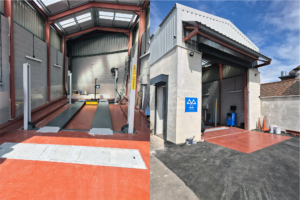
Effective 1 June 2026, MOT requirements for Class 7 testing stations will change.
Under DVSA Special Notice 01-26, zero-emission goods vehicles with a design gross weight between 3,501kg and 4,250kg will be classed as Class 7 vehicles and will need a Class 7 MOT test. These vehicles will receive their first Class 7 MOT three years after registration.
For many MOT test centres, this change represents both a regulatory update and a commercial opportunity.
Battery-electric vans and other zero-emission goods vehicles are often similar in size to existing Class 7 vehicles, but their batteries can increase their design gross weight. According to the DVSA, including these vehicles in Class 7 testing will increase HGV testing capacity and encourage the adoption of zero-emission vehicles in haulage fleets.
If you run a Class 7 MOT test centre, you should now consider the following question:
Can our existing Class 7 MOT lift safely handle vehicles up to 4,250kg?
The Hidden Issue: Not Every Class 7 MOT Lift is Ready
A DVSA survey found that 80% of Class 7 testing stations used lifts. Of these, 18% had a safe working load between 3,500kg and 4,000kg, 3% between 4,001kg and 4,250kg, and only 79% had a safe working load above 4,250kg.
Upgrading to compliant lifts helps your MOT test centre avoid service gaps and lost revenue, attract new customers, and capitalise on the 4,250kg vehicle testing opportunity.
By reviewing your lift capacity and test lane configuration, you can maximise MOT revenue, maintain workflow, and ensure readiness for heavier zero-emission vehicles, turning a potential challenge into a competitive advantage.
Why You Should Act Now
Remember, the new rule takes effect at the beginning of June 2026. While you might be tempted to wait until these vehicles start turning up for testing, delaying preparations may expose you to three avoidable issues.
First, there is a risk of lost MOT revenue. If a customer presents a 4,250kg zero-emission goods vehicle and your lift cannot safely accommodate it, the business may be lost to another provider.
Second, there is an operational concern. DVSA requires Class 7 testing stations to accept these zero-emission goods vehicles. However, if a vehicle is presented laden and cannot be safely tested, the test may be declined, or the presenter may need to unload the vehicle.
Third, there is a risk to your reputation. Fleet operators value reliability. If your MOT centre can promote its readiness for 4,250kg zero-emission vans, you reinforce your position in a changing market.
Upgrade Your Class 7 MOT Bay with V-Tech Garage Equipment
At V-Tech Garage Equipment, we supply and install premium garage equipment nationwide, including MOT bays, HGV brake testers, commercial column lifts, vehicle lifts, jacking beams, and pit jacks. We are a one-stop shop, offering you equipment from leading European brands.
For Class 7 operators reviewing their MOT bay, V-Tech offers replacement lift options, complete MOT bay packages, and ATL solutions. Our Class 7 MOT equipment range includes 4-post lift bays, scissor lift bays, jacking beams, brake testers, radius plates, and play detectors.
We also provide 5-tonne Class 7 lift options, including a 5-tonne ATL Class 7 4-post lift and a 5-tonne Class 7 scissor lift. You should consider these higher-capacity solutions when preparing for 4,250kg zero-emission goods vehicle MOT demand.
New Class 7 ATL Bay or Lift Replacement?
Not every MOT centre requires a complete bay replacement. Some may only need to replace an under-rated Class 7 lift. Others may use this change as an opportunity to modernise to one-person testing.
We offer Class 4 and Class 7 ATL MOT bays. Automated Test Lanes reduce labour requirements, as only one person is needed to test a vehicle, compared to standard MOT bays that require multiple technicians. Our ATL packages include essential MOT bay equipment, such as a brake tester, emissions analyser, headlamp aligner, radius plates, jacking beam, play detector, and a choice of 4-post lift, scissor lift, or pit-based installation.
As an existing Class 7 test centre, you should follow this simple checklist:
- Check your current lift’s SWL and capacity
- Confirm whether it can safely support zero-emission goods vehicles up to 4,250kg DGW
- Assess whether your brake tester, jacking beam, play detector, and lane layout remain suitable for the work you aim to secure
- Update your equipment before demand increases
Turn the DVSA Change into a Revenue Opportunity
This DVSA update is not solely about compliance. Upgrading your MOT test centre can expand your service offering, retain customers, attract new business, and meet the needs of future commercial vehicles.
Fleet operators are already transitioning to electric vans and zero-emission goods vehicles. From June 2026, many of these vehicles will require Class 7 MOT testing. MOT centres equipped to handle 4,250kg zero-emission goods vehicles will be better positioned to attract fleet work, retain local van operators, and win customers from sites that have not upgraded.
Don’t wait. If your Class 7 MOT lift is rated below 4,250kg, or if you are unsure about your test lane’s capacity, act now to secure your future business.
Contact V-Tech Garage Equipment now for a free review of your Class 7 MOT bay. Receive expert advice on the best upgrade options, including 4-post lifts, scissor lifts, ATL bays, or full MOT equipment, to ensure you are prepared for the 4,250kg market.
Call 0208 498 1288 or email sales@v-techuk.com today to discuss your upgrade and prepare your MOT centre for 4,250kg zero-emission vehicles. Don’t miss out. Take action now to capture this new business.