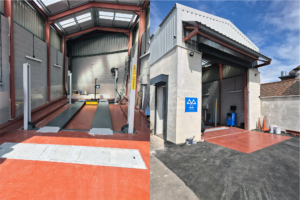
When a workshop already has a good inspection pit, the most practical route is often to make better use of what is already there.
That was the case at Fordbridge Service Station in Ashford, Surrey, where they wanted to update their existing vehicle inspection pit and convert the bay into a modern Class 4 ATL MOT test lane.
The project called for more than simply supplying and installing MOT equipment. The workshop needed a test lane layout that worked with the building, the pit and the day-to-day flow of vehicles through the site. They also needed advice on the DVSA VT01 application, including the drawings, equipment planning, and site access requirements, which can make or break an MOT bay project.
We worked with the team at Fordbridge Service Station to design, supply and install a complete Class 4 ATL MOT testing solution around the existing pit.
The Brief
Fordbridge Service Station wanted a professional MOT bay that would allow the workshop to carry out Class 4 testing using ATL equipment, while keeping the existing inspection pit at the heart of the layout.
The main aims were clear:
- Create a Class 4 ATL MOT test lane using the existing pit.
- Install equipment suitable for modern MOT testing and workshop use.
- Keep the layout practical for technicians and vehicle movement.
- Provide a complete ancillary pack so the bay is properly equipped.
- Support the DVSA VT01 process with practical advice and layout guidance.
- Identify any building or access issues early, before they become a problem during authorisation.
That last point mattered. During the planning stage, it became clear that the existing roller shutters did not meet the access requirements for the MOT test bay. We advised on the issue so that the necessary building adjustments could be made as part of the wider project.
The Equipment Installed
The finished Class 4 ATL lane included a complete package of MOT testing equipment and supporting items.
A PD2700 Single-Sided Play Detector was installed to support steering and suspension checks from the inspection pit.
For a pit-based MOT bay, this is a neat and practical choice. The single-platform design allows the unit to be fitted to one side of the pit, helping the tester check movement in the vehicle’s steering and suspension components in a controlled, repeatable way.
The lane was fitted with a BM4010 Class 4 ATL roller brake tester, selected for its suitability in light vehicle MOT testing and pit-based installations.
The BM4010 is well-suited to this type of project because it can be installed as a split-bed brake tester over an inspection pit. That makes it a strong fit when a workshop wants to upgrade an existing pit rather than start again with a completely different bay layout.
Fordbridge Service Station also received a headlamp aligner with longitudinal laser alignment, giving the workshop a dedicated unit for headlamp aim checks as part of the MOT process.
The longitudinal laser alignment helps the tester position the equipment accurately in relation to the vehicle, supporting clear, consistent headlamp testing within the lane.
A 2-tonne extra-wide jacking beam was supplied for the inspection pit.
This gives the workshop a practical lifting solution for MOT checks, wheel-free inspections and under-vehicle work. With modern vehicles getting wider, heavier and lower, the extra-wide jacking beam gives the team more flexibility across a wider mix of Class 4 vehicles.
The installation also included a V-Tech Combi Emissions Analyser, giving the workshop gas and smoke emissions testing capability in one integrated PC-based unit.
For a busy MOT bay, having the right emissions equipment in place from day one helps keep the test process smooth and avoids the need for separate workarounds later.
- Full ATL MOT bay ancillary pack
To complete the MOT bay, Fordbridge Service Station received a full ancillary pack, including:
- Convex mirrors
- MOT wall charts
- Decelerometer
- MOT tool board with tools
These items may not be the biggest pieces of equipment in the lane, but they are part of what turns an equipment installation into a working MOT bay. They help keep the bay organised, compliant and ready for daily use.
Supporting the DVSA VT01 Application
A key part of this project was supporting Fordbridge Service Station through the DVSA VT01 application process.
For many garages, this is where MOT bay projects can become frustrating. The equipment may be right, but the application still needs the correct details, drawings and supporting information. The premises also need to suit the class of vehicle being tested.
We provided advice on the VT01 process, including the test bay layout and the practical requirements for access to the MOT bay.
During this stage, an issue with the roller shutter door was identified. The existing shutter arrangement did not meet the requirements for access to the MOT test bay, so adjustments to the building were needed.
Spotting that early helped keep the project moving in the right direction. It also meant the workshop could deal with the building requirements as part of the setup, rather than discovering them too late in the process.
The Result
Fordbridge Service Station now has a Class 4 ATL MOT test lane built around its existing inspection pit, with the right mix of equipment for MOT testing and day-to-day workshop use.
The completed lane brings together:
- A pit-based play detector.
- A Class 4 ATL roller brake tester.
- Headlamp alignment equipment.
- A 2-tonne jacking beam.
- Combined petrol and diesel emissions testing.
- A complete MOT ancillary pack.
V-Tech’s support with layout planning and DVSA VT01 preparation also helped the garage deal with the practical details that sit behind a successful MOT bay project.
For Fordbridge Service Station, the upgrade makes better use of the existing workshop space and provides a modern testing lane that is ready to meet the demands of Class 4 MOT work.
Planning a Class 4 ATL MOT Lane?
Every MOT bay project is slightly different. Some workshops are starting with a clear floor. Others, like Fordbridge Service Station, already have an inspection pit that can be adapted into a working ATL MOT lane.
The right answer depends on the building, the pit, vehicle flow, access, equipment position and DVSA requirements.
We can help with site surveys, MOT bay planning, equipment supply, installation and advice around the DVSA VT01 process.
To discuss a Class 4 MOT bay, ATL upgrade or inspection pit conversion, call us today on 0208 498 1288 or email sales@v-techuk.com, and one of our project managers will be in touch to get you started.